It's been a good run, y'all (in fact, its been running for a little over twelve years!), but I'm going to call it quits on Spacebeer, at least for now and in this form.
If you like my book reviews, please add me over on Goodreads (my profile is set to private, but I'll accept all requesters), where I will continue to log and more briefly review all the books I've read. For those of you who are also real-life friends with me, I'll also post my Goodreads reviews to facebook.
I'll keep this blogger site up as long as blogger is a thing (because, to be honest, I sometimes scroll through my #secretboyfriend posts when I'm having a bad day). And don't worry, I have all my posts backed up locally as well -- I'm an archivist, after all!
So, cheers. And give me another spacebeer, Gleep Glop.
Monday, March 27, 2017

Saturday, March 04, 2017
The Death-Ray by Daniel Clowes (2011)

We meet Andy as a middle-aged man -- he is divorced, lives alone, is pretty bitter, and seems to be a very lonely, isolated guy. Nothing new for Clowes readers here. Then we go back to the origins of Andy as an isolated, lonely teenager with one friend, the too-mature, bit of a dickweed, Louie. Andy lives with his senile grandfather, both his parents having passed away.
Louie offers Andy his first cigarette one day, and that's when Andy realizes that tobacco has an unexpected affect on him. It turns out that before his father died, he treated Andy with an experimental serum that would unleash super powers whenever he smoked a cigarette. Oh, and he also left him a ray gun that can kill people.
As you may imagine, combining the potential for superpowers with the emotions and decision-making skills of a teenager gives us some intriguing results.
While the super-hero angle is not really something I expected from Clowes, the characters of Andy and Louie fit right into the Clowes pantheon. The story, which originally appeared in the Eightball series in 2004, is approached creatively with different length strips coming at the character of Andy and his actions from varying perspectives. The large format book serves the art well, giving room for the short and long sections to combine into a powerful narrative. This is one worth checking out, both for Clowes fans and for those who don't know they are Clowes fans just yet.
Sunday, February 19, 2017
The New Jim Crow: Mass Incarceration in the Age of Colorblindness by Michelle Alexander (2010)

Alexander argues that the system of mass incarceration of African American men justified by a racially biased "war on drugs" is a system of control for the black population of the United States that takes the place of the previous institutions of slavery and Jim Crow. Because we now live in a society that sees itself as colorblind, replacing the fear of people because they are black with a fear of people because they are criminals (who happen, because of unfair application of the law to almost all be black) is a way for us to continue a system of institutional racism while at the same time pretending that we aren't still racist. And, because of laws restricting the ability of convicted felons to vote, get jobs, serve on juries, receive food stamps, or get housing assistance, we have created a subclass of Americans that can never fully participate in our society.
This book is seven years old now and in a Black Lives Matter world, some of her conclusions that at the time seemed revelatory now seem like common sense. That doesn't mean that there isn't something worth digging into here. On the contrary, Alexander's carefully researched and impassioned arguments add heft and immediacy to a state of institutional racism so ingrained in American society that many of us (particularly middle-class white women like myself) can usually pretend that it doesn't exist. While much of what she outlines was not a surprise to me, I did learn a huge amount about the impact of supreme court decisions on the ability to fight racial bias in the justice system, and Alexander's experience as a civil rights lawyer gives the reader a close-in view on the ability to fight discrimination through legal cases.
Alexander's argument is focused and pointed -- I would have liked to see more inclusion of how mass incarceration affects black women, as well as how the church has been and still is involved in these communities, but I realize you can't fit everything into one book. Rather than putting out a call for specific action, the last chapter guides the reader through a series of open questions, and sets the stage for a companion volume (which I've bought but haven't read yet) called Building a Movement to End Jim Crow by Daniel Hunter. I'm interested to dig into that book and see where it leads. Reading and talking about racial issues can make us uncomfortable, but I think white women like me need to get a little better at being uncomfortable sometimes and facing these issues that other people in our community don't have the option of ignoring.
Wednesday, February 01, 2017
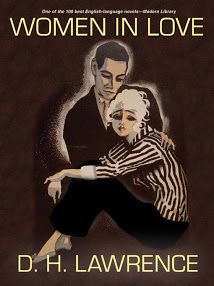
Women in Love by D. H. Lawrence (1920)
He put his hand to his
mouth and threw his cigarette away, a gleaming point, into the unseen hedge.
Then he was quite free to balance her.
‘That’s better,’ he
said, with exultancy.
The exultation in his
voice was like a sweetish, poisonous drug to her. Did she then mean so much to
him! She sipped the poison.
‘Are you happier?’ she
asked, wistfully.
‘Much better,’ he
said, in the same exultant voice, ‘and I was rather far gone.’
(page 324)
Women in Love by
D. H. Lawrence (1920) is my next pick from Harold Bloom’s Western Canon list which, frequent readers of this infrequently updated blog will remember, I am
reading in reverse alphabetical order by title.
I don’t know if I’ve ever had so many strong (negative and
positive) feelings for a single novel in my life. My one other experience with
Lawrence was reading Lady Chatterley's Lover
in college and really not caring for it at all. Either Women in Love is a better novel or 40 year old Kristy has a
perspective that 20 year old Kristy didn’t have, because while I struggled
pretty heartily with parts of this long saga, in the end I honestly really
loved it. My friend Daniel’s advice to imagine all the characters as Edward
Gorey drawings, really helped.
The plot is intense and complicated on one hand and as
simple as a soap opera on the other. Wikipedia describes it like this: “Gudrun
Brangwen, an artist, pursues a destructive relationship with Gerald Crich, an
industrialist. Lawrence contrasts this pair with the love that develops between
Ursula Brangwen and Rupert Birkin, an alienated intellectual who articulates
many opinions associated with the author. The emotional relationships thus
established are given further depth and tension by an intense psychological and
physical attraction between Gerald and Rupert. The novel ranges over the whole
of British society before the time of the First World War and eventually
concludes in the snows of the Tyrolean Alps.”
While the action of the book takes place before World War I,
you can almost feel the post-War fatigue and abandon dripping off of the pages
here. Lawrence’s work had been banned before, and this book follows the same
pattern. The characters are restless, seeking something that can’t be pinned
down, playing with each other, their sexuality, and their social class.
Bixsexuality, anal sex, pre-marital sex, and the crazy idea of never wanting to
get married at all are all mixed in to this story that mostly takes place in a
pretty conservative small coal mining town in the midlands of England.
Several years ago I watched the 1969 Ken Russell version of
Women in Love (trailer here),
which stars Oliver Reed (the most Ken Russell-y of all actors) and generally
lives up to what you might imagine from such a combination of book and director.
To be honest, I didn’t remember much about the movie except that Glenda Jackson
was awesome in it and a rather odd nude wrestling scene between the two male
leads that took place on a bear-skin rug in front of a fireplace. I imagined
that the wrestling scene and some of the other excesses of the movie were part
of the Ken Russell touch, but was intrigued to find them all intact in the
source material. Lawrence and Russell were really made for each other.
I think what charmed me more than anything else in this
novel is Lawrence’s amazing use of language. He repeats words, lengthens and
shortens sentences, occasionally sneaks in a first person sentence amongst
chapters of third person perspective, and generally exhibits the freedom in his
descriptions that his characters are exploring in their relationships. I realize
this is probably going to be dull for anyone but me, but I’m going to conclude
with a few of my favorite snippets. The last one is really long, but so so
worth it. If you are intrigued, you can help yourself to the full ebook here.
Let's start with Gerald entering a café in Paris:
They met again in the
cafe several hours later. Gerald went through the push doors into the large,
lofty room where the faces and heads of the drinkers showed dimly through the
haze of smoke, reflected more dimly, and repeated ad infinitum in the great mirrors
on the walls, so that one seemed to enter a vague, dim world of shadowy
drinkers humming within an atmosphere of blue tobacco smoke. There was,
however, the red plush of the seats to give substance within the bubble of
pleasure.
Gerald moved in his
slow, observant, glistening-attentive motion down between the tables and the
people whose shadowy faces looked up as he passed. He seemed to be entering in
some strange element, passing into an illuminated new region, among a host of licentious
souls. He was pleased, and entertained. He looked over all the dim, evanescent,
strangely illuminated faces that bent across the tables. Then he saw Birkin
rise and signal to him.
(page 56)
An example of why you may need to keep a dictionary nearby:
‘I think you are very
silly. I think you want to tell me you love me, and you go all this way round
to do it.’
‘All right,’ he said,
looking up with sudden exasperation. ‘Now go away then, and leave me alone. I
don’t want any more of your meretricious persiflage.’
‘Is it really
persiflage?’ she mocked, her face really relaxing into laughter. She interpreted
it, that he had made a deep confession of love to her. But he was so absurd in
his words, also.
(page 142)
I love the descriptions of the two men here:
Gerald fastened the
door and pushed the furniture aside. The room was large, there was plenty of
space, it was thickly carpeted. Then he quickly threw off his clothes, and
waited for Birkin. The latter, white and thin, came over to him. Birkin was
more a presence than a visible object, Gerald was aware of him completely, but
not really visually. Whereas Gerald himself was concrete and noticeable, a
piece of pure final substance.
(page 263)
So over the top, and so perfect:
She looked up, and in
the darkness saw his face above her, his shapely, male face. There seemed a
faint, white light emitted from him, a white aura, as if he were visitor from
the unseen. She reached up, like Eve reaching to the apples on the tree of
knowledge, and she kissed him, though her passion was a transcendent fear of
the thing he was, touching his face with her infinitely delicate, encroaching
wondering fingers. Her fingers went over the mould of his face, over his
features. How perfect and foreign he was — ah how dangerous! Her soul thrilled
with complete knowledge. This was the glistening, forbidden apple, this face of
a man. She kissed him, putting her fingers over his face, his eyes, his
nostrils, over his brows and his ears, to his neck, to know him, to gather him
in by touch. He was so firm, and shapely, with such satisfying, inconceivable
shapeliness, strange, yet unutterably clear. He was such an unutterable enemy,
yet glistening with uncanny white fire. She wanted to touch him and touch him
and touch him, till she had him all in her hands, till she had strained him
into her knowledge. Ah, if she could have the precious KNOWLEDGE of him, she
would be filled, and nothing could deprive her of this. For he was so unsure,
so risky in the common world of day.
‘You are so
BEAUTIFUL,’ she murmured in her throat.
He wondered, and was
suspended. But she felt him quiver, and she came down involuntarily nearer upon
him. He could not help himself. Her fingers had him under their power. The
fathomless, fathomless desire they could evoke in him was deeper than death, where
he had no choice.
But she knew now, and
it was enough. For the time, her soul was destroyed with the exquisite shock of
his invisible fluid lightning. She knew. And this knowledge was a death from
which she must recover. How much more of him was there to know? Ah much, much,
many days harvesting for her large, yet perfectly subtle and intelligent hands
upon the field of his living, radio-active body. Ah, her hands were eager,
greedy for knowledge. But for the present it was enough, enough, as much as her
soul could bear. Too much, and she would shatter herself, she would fill the
fine vial of her soul too quickly, and it would break. Enough now — enough for
the time being. There were all the after days when her hands, like birds, could
feed upon the fields of him mystical plastic form — till then enough.
(pages 326-327)
Gerald’s mother’s reaction to her husband’s death:
‘Ay,’ she said
bitterly, at length, speaking as if to the unseen witnesses of the air. ‘You’re
dead.’ She stood for some minutes in silence, looking down. ‘Beautiful,’ she
asserted, ‘beautiful as if life had never touched you — never touched you. God
send I look different. I hope I shall look my years, when I am dead. Beautiful,
beautiful,’ she crooned over him. ‘You can see him in his teens, with his first
beard on his face. A beautiful soul, beautiful —’ Then there was a tearing in
her voice as she cried: ‘None of you look like this, when you are dead! Don’t
let it happen again.’ It was a strange, wild command from out of the unknown.
Her children moved unconsciously together, in a nearer group, at the dreadful
command in her voice. The colour was flushed bright in her cheek, she looked
awful and wonderful. ‘Blame me, blame me if you like, that he lies there like a
lad in his teens, with his first beard on his face. Blame me if you like. But
you none of you know.’ She was silent in intense silence. Then there came, in a
low, tense voice: ‘If I thought that the children I bore would lie looking like
that in death, I’d strangle them when they were infants, yes —’
‘No, mother,’ came the
strange, clarion voice of Gerald from the background, ‘we are different, we
don’t blame you.’
She turned and looked
full in his eyes. Then she lifted her hands in a strange half-gesture of mad
despair.
‘Pray!’ she said
strongly. ‘Pray for yourselves to God, for there’s no help for you from your
parents.’
‘Oh mother!’ cried her
daughters wildly.
But she had turned and
gone, and they all went quickly away from each other.
(page 330)
And, finally, this one is so long that I had to save it for
last, but such an amazingly vital and weird scene that I couldn’t share just
part of it. If you think you’ll read the whole book, just skip this one
(although it doesn’t give too much away). If you love wild action, words that
just zing off the page, and the sexualization of plant life, then read on:
He went into her
boudoir, a remote and very cushiony place. She was sitting at her table writing
letters. She lifted her face abstractedly when he entered, watched him go to
the sofa, and sit down. Then she looked down at her paper again.
He took up a large
volume which he had been reading before, and became minutely attentive to his
author. His back was towards Hermione. She could not go on with her writing.
Her whole mind was a chaos, darkness breaking in upon it, and herself
struggling to gain control with her will, as a swimmer struggles with the
swirling water. But in spite of her efforts she was borne down, darkness seemed
to break over her, she felt as if her heart was bursting. The terrible tension
grew stronger and stronger, it was most fearful agony, like being walled up.
And then she realised
that his presence was the wall, his presence was destroying her. Unless she
could break out, she must die most fearfully, walled up in horror. And he was
the wall. She must break down the wall — she must break him down before her,
the awful obstruction of him who obstructed her life to the last. It must be
done, or she must perish most horribly.
Terribly shocks ran
over her body, like shocks of electricity, as if many volts of electricity
suddenly struck her down. She was aware of him sitting silently there, an
unthinkable evil obstruction. Only this blotted out her mind, pressed out her
very breathing, his silent, stooping back, the back of his head.
A terrible voluptuous
thrill ran down her arms — she was going to know her voluptuous consummation.
Her arms quivered and were strong, immeasurably and irresistibly strong. What
delight, what delight in strength, what delirium of pleasure! She was going to
have her consummation of voluptuous ecstasy at last. It was coming! In utmost
terror and agony, she knew it was upon her now, in extremity of bliss. Her hand
closed on a blue, beautiful ball of lapis lazuli that stood on her desk for a
paper-weight. She rolled it round in her hand as she rose silently. Her heart was
a pure flame in her breast, she was purely unconscious in ecstasy. She moved
towards him and stood behind him for a moment in ecstasy. He, closed within the
spell, remained motionless and unconscious.
Then swiftly, in a
flame that drenched down her body like fluid lightning and gave her a perfect,
unutterable consummation, unutterable satisfaction, she brought down the ball
of jewel stone with all her force, crash on his head. But her fingers were in
the way and deadened the blow. Nevertheless, down went his head on the table on
which his book lay, the stone slid aside and over his ear, it was one
convulsion of pure bliss for her, lit up by the crushed pain of her fingers.
But it was not somehow complete. She lifted her arm high to aim once more,
straight down on the head that lay dazed on the table. She must smash it, it
must be smashed before her ecstasy was consummated, fulfilled for ever. A
thousand lives, a thousand deaths mattered nothing now, only the fulfilment of
this perfect ecstasy.
She was not swift, she
could only move slowly. A strong spirit in him woke him and made him lift his
face and twist to look at her. Her arm was raised, the hand clasping the ball
of lapis lazuli. It was her left hand, he realised again with horror that she
was left-handed. Hurriedly, with a burrowing motion, he covered his head under
the thick volume of Thucydides, and the blow came down, almost breaking his
neck, and shattering his heart.
He was shattered, but
he was not afraid. Twisting round to face her he pushed the table over and got
away from her. He was like a flask that is smashed to atoms, he seemed to
himself that he was all fragments, smashed to bits. Yet his movements were
perfectly coherent and clear, his soul was entire and unsurprised.
‘No you don’t, Hermione,’
he said in a low voice. ‘I don’t let you.’
He saw her standing
tall and livid and attentive, the stone clenched tense in her hand.
‘Stand away and let me
go,’ he said, drawing near to her.
As if pressed back by
some hand, she stood away, watching him all the time without changing, like a
neutralised angel confronting him.
‘It is not good,’ he
said, when he had gone past her. ‘It isn’t I who will die. You hear?’
He kept his face to
her as he went out, lest she should strike again. While he was on his guard,
she dared not move. And he was on his guard, she was powerless. So he had gone,
and left her standing.
She remained perfectly
rigid, standing as she was for a long time. Then she staggered to the couch and
lay down, and went heavily to sleep. When she awoke, she remembered what she
had done, but it seemed to her, she had only hit him, as any woman might do,
because he tortured her. She was perfectly right. She knew that, spiritually,
she was right. In her own infallible purity, she had done what must be done.
She was right, she was pure. A drugged, almost sinister religious expression
became permanent on her face.
Birkin, barely
conscious, and yet perfectly direct in his motion, went out of the house and
straight across the park, to the open country, to the hills. The brilliant day
had become overcast, spots of rain were falling. He wandered on to a wild
valley-side, where were thickets of hazel, many flowers, tufts of heather, and
little clumps of young firtrees, budding with soft paws. It was rather wet
everywhere, there was a stream running down at the bottom of the valley, which
was gloomy, or seemed gloomy. He was aware that he could not regain his
consciousness, that he was moving in a sort of darkness.
Yet he wanted
something. He was happy in the wet hillside, that was overgrown and obscure
with bushes and flowers. He wanted to touch them all, to saturate himself with
the touch of them all. He took off his clothes, and sat down naked among the
primroses, moving his feet softly among the primroses, his legs, his knees, his
arms right up to the arm-pits, lying down and letting them touch his belly, his
breasts. It was such a fine, cool, subtle touch all over him, he seemed to
saturate himself with their contact.
But they were too
soft. He went through the long grass to a clump of young fir-trees, that were
no higher than a man. The soft sharp boughs beat upon him, as he moved in keen
pangs against them, threw little cold showers of drops on his belly, and beat
his loins with their clusters of soft-sharp needles. There was a thistle which
pricked him vividly, but not too much, because all his movements were too
discriminate and soft. To lie down and roll in the sticky, cool young
hyacinths, to lie on one’s belly and cover one’s back with handfuls of fine wet
grass, soft as a breath, soft and more delicate and more beautiful than the
touch of any woman; and then to sting one’s thigh against the living dark
bristles of the fir-boughs; and then to feel the light whip of the hazel on
one’s shoulders, stinging, and then to clasp the silvery birch-trunk against
one’s breast, its smoothness, its hardness, its vital knots and ridges — this
was good, this was all very good, very satisfying. Nothing else would do,
nothing else would satisfy, except this coolness and subtlety of vegetation
travelling into one’s blood. How fortunate he was, that there was this lovely,
subtle, responsive vegetation, waiting for him, as he waited for it; how
fulfilled he was, how happy!
As he dried himself a
little with his handkerchief, he thought about Hermione and the blow. He could
feel a pain on the side of his head. But after all, what did it matter? What
did Hermione matter, what did people matter altogether? There was this perfect
cool loneliness, so lovely and fresh and unexplored. Really, what a mistake he
had made, thinking he wanted people, thinking he wanted a woman. He did not
want a woman — not in the least. The leaves and the primroses and the trees,
they were really lovely and cool and desirable, they really came into the blood
and were added on to him. He was enrichened now immeasurably, and so glad.
(pages 98-101)
Sunday, January 01, 2017
Elizabeth Murray: Paintings and Drawings (1987)

The book begins with some introductory essays on Murray's paintings and drawings, followed by a section of reproductions, each annotated by the artist, and ending with a long interview with Murray. While I'm not sure that her work speaks to me 100% (and, honestly, I get the feeling that you need to see her work in person and not in small prints in a coffee table book), being able to read her annotations about her process and the thoughts behind the images was fascinating. Particularly in the world of abstract art, being able to combine your own response to the work on the page with the intention and process of the artist adds a real depth to the artwork.
I will be the first to admit that I don't know as much about art history and contemporary artists as I should, so I'm very happy that this collection fell into my hands!
Monday, December 26, 2016
The Story of Christianity, Volume 1: The Early Church to the Dawn of the Reformation by Justo L. González (2010)

Because this class covered about 1500+ years of human history, things had to move pretty fast by necessity, but having González's text to fill in some of the gaps and add a foundation to the lectures and class discussions was really helpful. I'm no Christian history expert, but I felt like this book gave me just the right amount of detail and context to explain the implications of events, without getting too lost in the weeds of historical detail. The book is well laid out and includes some pictures to break up the historical events. Starting back in the events of the New Testament, this volume takes us all the way up to the very start of the Protestant Revolution (which is picked up at the start of the second volume by González, which I'm working my way through now -- can't wait to find out what happens next!).
One thing I wasn't expecting to have to conquer in church history was a philosophical understanding of the different theological controversies that have rocked the church (and particularly the early church) over the years. I'm basically familiar with Christian theology, but my mind was a little blown when we really started digging into the Trinity and Christological interpretations. Probably will not be embedding myself into the Systematic Theology class anytime soon.
Regardless of how you feel about Christianity, there is no denying the huge impact it has had (and continues to have) on the political, cultural, and social history of the Western world. I feel like my dip into a survey of Christian history has given me a better launching pad for understanding the world around me and how it ended up this way (for good and for bad). It is also really helping stoke my fascination with the English royal family, although that shows up more in Volume two....
Saturday, December 10, 2016
Roald Dahl's Book of Ghost Stories, edited by Roald Dahl (1984)

Weird, sexist, and rambley old man introduction aside (seriously, Roald Dahl, why do you have to be so beloved AND so crotchety?), this is a great collection of creepy short stories -- mostly from the 1950s, but with some intriguing earlier stories as well. My personal favorite was the one written by one of the only authors in the collection that I knew beforehand, "Afterward" by Edith Wharton. "The Telephone" by Mary Treadgold and "The Sweeper" by A.M. Burrage were also pretty great.
As one member of the book club pointed out, the thing about an anthology of ghost stories is that you know for certain that at the end, that weird guy or beautiful woman or adorable kid on the playground is going to end up being a G-G-G-G-GHOST! I don't mind, though, as the satisfying ghost ending is all part of the fun.
It would be perfect to follow up reading these stories with a late-night viewing of Crimson Peak... Highly recommended for anyone who likes some classic short fiction and a good (mild) scare.
Subscribe to:
Posts (Atom)